Whole Fish

Gulf Seafood + Southern Food


Luna & Caz

Last Sunday was a benchmark day for me and my three-man crew: James Cheramie, Dan Lantini (from Barstool Magazine) and Chef David Luna from Shade.


Lantini Working the Bow
Cheramie with Bull Red

Seas were 1 to 2 feet (see swell height ), blue water was in close and weed lines were forming just five miles off the beach head. In every direction you looked, the entire Gulf was alive, teeming with massive bait pods, Gulls and Terns pounding the water’s surface, thrashing Spanish Mackerel, bruiser Kingfish and Cobia!

Within five minutes of rolling up to the first rig, the anchor hadn’t even caught, and Dan was hollerin’ almost as loud as his Ambassador 7000 was screaming, “I’m on, baby!” It was that quick: four Kingfish in the boat before I could even wet a line. And that’s the way it was for about one and a half hours.


Luna with Kingfish

Then I noticed something: on the Southeast corner of the rig, a beautiful and wondrous sight -- nervous water. Large bait pods of Atlantic Bumper and Spanish Sardine huddled ever-so-close to the rig’s pylons, nervous as Tom Turkey in Dog Town.

Searching for Nervous Water

Keeping a close eye on it, I knew it was no lie, something had ‘em spooked. And then it happened…BAM! The surface erupted -- murder and mayhem, scales and hard tails flying in random directions. They scattered hard, then regrouped even tighter than the rush hour crowd on the 6 train. Then BAM!, again. Ooohh, son! Something big was methodically working the edges. This was no Mackerel, this big guy had shoulders and was throwing his weight around.

I was about to come out of my skin with anticipation. Repositioning the boat, I palmed that baby up to the edge of the ruckus. Dan chunked a frozen sardine on a float and, almost instantly, a massive shadow emerged from the rig pilings, rushing Dan’s bait but stopping inches short, turning up his nose at the frozen offering. Sure enough, it was a big-ass Cobia. As quick as I could, I snatched up my live bait rig, single hook and 80 pound mono leader (make no mistake, I might be big and a bit clumsy, but at moments like these, you sometimes only get one shot -- clarity is key and, baby, I’m a killer). I grabbed one of the live Spanish Sardine that I caught earlier jigging Sabiki and
pitched it lightly, landing it just shy of Dan’s float. The Cobia charges the frantic Sardine, mouths it, spits it, circles, takes a dramatic pause, then hits it like a Tyson right cross, inhaling the bait and then taking off like a champagne cork. It was on! A rush of adrenaline blasted through my veins as this 40-plus pound monster manhandled me from port to starboard, making me doubt what I’ve come to believe: my knots, my drag, this crew, my religion. I started coaching Luna on his gaff technique, as if he grew up in Montana, spewing anxious, incoherent chatter that gets me a stern look from him and he finally says, “Dude, I got it.” Then, the giant hits the deck – pay dirt, baby! I really should give lessons.

This was the kind of day that sticks with you, like a Rueben at 2nd Ave Deli, weighing you down, swelling your thoughts of the next trip. And I’ve been obsessing ever since.


Tripletail

West Matagorda
has always been my fishing home base. One of the unique things about this bay is the large number of inshore gas platforms that offer great surface structure in an otherwise structure-less bay. Each rig reaches 12 feet down to the bottom of the bay and has become a reef of sorts; the large oyster shell pads that were built on the bottom to reinforce the platform, although man-made initially, have become alive over the years, creating an eco-chain of life out in the middle of the bay. They are also the reason why West Matagorda Bay is the Tripletail capital of Texas.

Tripletail (aka Black fish, Drift Fish or Buoy Fish [Lobotes surnamensis]) gets its name because the second dorsal and anal fins that extend far back on the body make it look like it has three tails. Although it is the only representative of the Lobotes family in the Gulf, many wrongly believe it is related to the Cichlid family because of its striking resemblance to the fresh water “Sac-a-lait” or Crappie. Tripletail is a surface fish that hangs out next to any kind of top water structure like platforms, sargassum, buoys and flotsam and jetsam. I caught this one last week off of a large piece of driftwood about one and half miles offshore of the Galveston jetty.


That's me with a Tripletail

A Tripletail will lie on its side, as if it was part of whatever floating material it’s hiding in; floating and moving with the current and waves like a large leaf, it even has the ability to change its color, like a chameleon. Years back, most people would steer clear of Tripletail as table fare thinking that these characteristics meant that the fish was sick. But it’s not sick, it’s smart: it lays in wait, ready to spring on its prey. When it attacks, it rushes, swimming on its side just like a flounder. But once it is hooked, it rights itself, turns that broad body and uses it against you. They are infamous as tough fighters that will frequently return to their former hiding spot, wrapping you around the seaweed or driftwood or whatever they were using as cover, and breaking your line. Tripletail feed mostly on menhaden, herring, anchovies and some crustaceans and live in subtropical and tropical coastal regions and estuaries from Massachusetts to Argentina. Rarely traveling in groups of more than three, they reach sexual maturity in just a year, making it an easily sustainable and recovery species. When large enough, they yield a wonderfully flaky white fish reminiscent of a giant speckled trout or weakfish. Although difficult to cook on the grill, they are excellent on the flat top or in a sauté pan.


Roasted Tripletail, Smoked Dr. Pepper Glaze, Buttered Bok Choy, Grapefruit Soda

The first day of Snapper season was a good one but the story of the day belonged to 13-year-old Ryan Smith.


Ryan with snapper and father Cameron

When we reached our Snapper quota, our focus shifted to Kings and Cobia. We had already landed a couple of Sand Sharks, a Bonnet Head and busted off on a pretty big Cobia when one of the reels began to scream. Ryan quickly grabbed the rod, flipped the bail and set the hook, but this big boy wasn’t turning. He kept peeling off line like a freight train and wouldn’t stop. Quickly, John cut us loose from the rig, I fired up the engines and tried to give young Ryan a bit of help. Ryan had been putting the screws to this hoss for about an hour before we even caught our first glimpse of him: it was a Black Tip Shark and Lord was he big -- between 6 and 7 feet, a true monster tipping the scales at about 150 pounds. A good match for Ryan, who weighs about the same.


Ryan Doing Battle

My friends, I must tell you, the fight that Ryan put on that fish was of epic, Hemingway proportions. This young man was truly a sight to see: his hands were cut up and burned, back aching and the butt of the rod had started to wear a hole in his gut, but he refused to give up. One and a half hours after our first hook up, we got the first pass on the monster and we all took our stations, ready to do battle. Once close enough, I went in hard for the gaff and, as soon as I made contact, the shark flipped and dove hard, leaving my brand new gaff in shambles, bending the metal shaft straight as an arrow. He made a second and third pass and, on the third, he thrashed, spun on the leader and cut the line. I wish you could have seen this one but unfortunately, when the bite is really on, everyone picks up the rod not the camera.

Two hours had passed and, as we watched that monster slowly swim off, I wanted to cry. I looked over at Ryan -- he didn’t say a word, just set the rod down, walked to the front of the boat, lay down and passed out, exhausted. It was an inspirational fight.


Like many Houstonians, I lost a lot to Ike but none as painful to me as the loss of my 22.5 foot Marshall. It wasn’t so much the boat itself as the peace of mind that going out gave me – it was a kind of therapy for me. That boat kept me on an even keel in my life on land.

In my family, we traditionally greet each Hurricane headed our way with a party, making the rounds to one or two houses in our neighborhood to have cocktails before the big storm hits. Last year, the hours before Ike were no different: drinks at the McLemore’s, then it was off to batten down the hatches at home and ride out the storm. I was rounding third with my Turkey & Soda when I glanced at the T.V. and saw the thick black smoke bellowing from a coastal building in Galveston. My heart sank to my stomach – is that the dry storage at the yacht basin? It sure did look like it.


And it was.

Heartbroken I was, she wasn’t even a year old. Earlier in the year, my brother Mike and I bought the boat together from Norman Marshall of Marshall Marine out of Port Lavaca, TX - they craft one hell of a boat.

Last summer, I fished more than I have in about 15 years. I enjoyed the hell out of that Marshall. But, thanks to Ike, I haven’t been out for almost 8 months - the longest I’ve ever gone without a trip.

I have been running boats since I was 8 years old. When I detach from the shoreline, it’s as if the cord that tethers me to everything else has been cut and I run only local channels: no calls, no emails, no texts and no more everyday problems. It’s just clear, pure thought - freedom for just a while, true serenity, a bit of peace. There’s nothing but me, the crew and our mission.

Here are a few pictures from last summer’s excursions:


Heaven on Water, 2008

It has taken me some time, but we have commissioned a new vessel, as yet to be named but definitely seaworthy: the legendary, unsinkable Boston Whaler.


Boston Whaler

At a solid 26 feet, she’s a big ‘un! My largest ever, technically a yacht (this is the classification for a boat that breaches 25 feet), this boat breaks new ground for me -- now the fabled Flower Gardens, Boomvang, Tequila rig and The Claypiles, all 50-100 miles offshore, are within my grasp (all of these are underwater goldmines for fishermen).

After two prior failed attempts due to small mechanical difficulties, Monday, June 1st marked the Whaler’s maiden voyage offshore, to the tune of about 25 miles. With my buddies -- Farrar, Cameron Smith and his 13-year-old son, Ryan -- we headed out for the opening day of Snapper season. If it’s Duck, Dove, Deer or Snapper, for a guy like me, opening day is always mandatory attendance.

This year, I’m pretty sure I’m going to need a lot of therapy.

Farrar & me, double hookup
Here's to many tight lines for my brother and I in the future!!


Salt Dome reef, teeming with sea life (Flower Gardens Creole Fish)

There are so many reasons why I love salt. Without a doubt, it is the most important of culinary ingredients. The value of salt truly knows no bounds, but did you know that salt is also responsible for some of the most exciting and productive fishing grounds in the Gulf Coast?

Well, salt domes to be specific. A salt dome is a vertical cylinder of salt that starts out below the Earth’s surface but, because the density of salt is less than that of most other sediments & minerals, pushes up towards the surface with a big, bulging dome or cap rock on top. It’s hard for me to comprehend but salt will actually flow upward through these sediments and rather quickly (in geological time, anyway).


Seismic grap of salt dome / 3D digital rendering of salt dome
Sources: www.tsunamidevelopment.com / www.gocad.ensg.inpl-nancy.fr
If you have ever heard of salt domes it was probably in relation to oil. The Spindletop “discovery” in Beaumont was where oil was first found in the uplifted sediments around a salt dome. Salt domes are good indicators of where oil and natural gas may be found because, as the salt pushes its way through the rock toward the surface, the salt can crack the rock (creating faulting) so that oil and gas deposits get trapped and accumulate. Salt domes are also used for salt and mineral mining and to create bases used in the production of other chemicals (like chlorine); and, it turns out, they make excellent, leak-proof storage containers for all sorts of things (from oil to hazardous waste).

That’s all great, but my undying affection for salt domes comes from other reasons.


One reason is the Flower Gardens, probably the coolest thing that exists in the Gulf of Mexico: a live coral reef located 110 miles South of the Texas-Louisiana border that has formed on top of an underlying salt dome, basically out in the middle of nowhere. Discovered in the 1900’s by Snapper fishermen, it was named the Flower Gardens because of the brightly colored sponges, corals and algae that got snagged on their lines.

The Flower Gardens is the northernmost coral reef in the United States and consists of three main sections: East Flower Garden, West Flower Garden and Stetson Bank (which is 30 miles closer to shore). These three separate zones support an amazing sea life community of Loggerhead, Leatherback and Hawksbill Sea Turtles (all endangered) and serves as a nursery for juvenile Manta Rays. In total, The Flower Gardens support 21 species of coral, 175 species of fish, 250 species of macro-invertebrates and 80 species of algae. Designated as a national sanctuary in 1992, some recreational and commercial fishing is allowed (no spear-fishing or long-lining) but scuba diving is the main attraction here.


Flower Gardens: Bright Bank / Warsaw Grouper


Flower Gardens Manta Ray

And the other reason is Sackett Bank.

The Sackett Bank, better known as The Midnight Lump, is a natural salt dome that rises from 400 feet below to about 200 feet above the water’s surface and covers almost a square mile. Heavy currents from the shotgun waterway, The Mississippi (thank you Corps of Engineers), cause huge upwellings, attracting the bait that brings the big fish, making this the go-to place for Yellowfin tuna, Wahoo, Billfish and many other species. The Midnight Lump (or just “the Lump,” as most call it) lies about 16 miles Southwest of the Mississippi Delta’s Southwestern pass, just south of Venice, the river’s last populated port. It was named Midnight Lump because, in order to hit the mother lode of Red Snapper that congregated at the bottom of the dome, you had to fish it at midnight to sneak baits past the hordes of Kingfish and Bonita that swim the waters above the Snapper.


Map of Sackett Bank (aka Midnight Lump)

The Lump might be slightly out of my range but not the Flower Gardens. This summer, “gardening” is high on my list of priorities. I’ll be working on my green thumb, baby!


Flower Gardens Photos: http://flowergarden.noaa.gov/


Cobia

I nearly lost a good friend over a 50-pound Cobia and that’s no joke.

It was my first trip out with my buddy, Scott McLemore, on his boat, the Julie-Ann. We were about 60 miles offshore, Snapper fishing mainly, but I had been chumming religiously all day, free-lining two Ribbonfish rigs in hopes of tight lines. We had already hooked up with one small Kingfish
when I looked up and saw a monster Cobia explode on the water’s surface and turn on the bait. These are the moments I live for, intense adrenaline running through my veins as the drag begins to squeal and line spools out so fast that, if not careful, it will burn right through your finger. I shot up, set the hook and immediately turned to Scott and started screaming, “I Got Him!” Scott was already right next to me with open arms waiting for the rod. (Offshore 101: it takes 3-4 people to work a big boat while offshore, so etiquette states that each man takes his turn at the rod, especially while fishing for the larger pelagic since they usually only strike in singles and it is a collective effort for that tight line.) By the look on Scott’s face, it was obvious that he figured it was his turn. I looked down at the rod, back up to Scott’s face and back down to the rod once again, weighing our friendship against the odds of experiencing such a monster in the future. For a split second, I hesitated and thought about keeping the fish. I mean, when will I ever get a chance to land a 50-pound Cobia? (I still haven’t, by the way.) Well, I chose to keep the friend over the fish.


Scott and I with that Big-Ass Cobia

Lemon Fish, Crab Eater, Ling, Sergent Fish, Cobia (Rachycentridae Canadum) -- these are all names for one of the most sought-after game fish in the Gulf, prized most likely because of its propensity for swimming close to shore and its tenacity as a fighter. Land a Cobia and you’re sure to have a story to tell back home During the summer months, you can see boats cruising the beachfront from Florida to Texas with spotters standing at the highest point, searching. Lord knows I burned plenty of gas trying to track them down myself. Cobia have flat heads and a distinctly shark-like appearance while swimming; they average 3-7 feet long and 20-30 pounds (although the world record weight for one is 135 pounds). A Pelagic fish, they are the only member of the Rachycentridae family and are found world-wide in warm waters (but are most populous in the Gulf of Mexico). Cobia have an extremely fast growth rate which has made them perfect candidates for open ocean aquaculture.


Aquaculture

While at the Boston Seafood show, I saw an open aquaculture vendor calling them “Black Salmon” – kind of a stretch. They are mostly found congregating in twos and threes around reefs, buoys, pilings, wreckage and anchored boats and will follow larger animals like sharks, turtles and manta rays looking for table scraps. Their diet consists mainly of crustaceans, hence the name Crab Eater.

Cobia flesh has a steak-like quality, similar to Swordfish but with a higher fat content and fuller flavor, which makes it perfect for grilling as well as sashimi. If cooking on the grill, take special care not to cook it past medium, as it will get very dry if overcooked.

Grilled Cobia, Plantain and Long-Bean Sauté, Pickled Plum Jus


Blackfin Tuna

Usually, when the subject of Tuna comes up, you will hear grandiose talk of the superstars Bluefin, Yellowfin, Albacore, Big-Eye or, if you are one of the lucky ones, Toro. No one hardly ever talks about this black sheep of the family, Blackfin – could it be its smaller stature, or that it often gets confused with Bonito or that its sheer numbers and tenacity make it a real pest when trying to snag its larger cousins. If you’ve ever been offshore in a Tuna feeding frenzy, under the lights, you know what I mean. When the heat is on and time is of the essence, a 150 pound Yellowfin is always preferred to a 15 pound Blackfin, at least to your regular sports fisherman (guess I’m not such a regular guy after all).

Blackfin Tuna (Thunnus Atlanticus), also known as Bermuda Tuna, Blackfinned Albacore and Football, is a member of the Scombridae family. They range in size from 2 – 20 pounds with the largest catch on record being 45 pounds. There is some commercial interest in this fish worldwide, but virtually none in the Atlantic and Gulf regions. Blackfin are a Pelagic Species found in warmer tropical waters from Brazil to Cape Cod in large schools, usually around other tunas. They eat less fish than other members of the Tuna family and more shrimp, crab and squid, but they are one of the fastest growing tunas and reach sexual maturity in less than two years. A five-year-old Blackfin is considered old. Because of its ability to procreate quickly and its rapid growth, I see no reason why this fish is overlooked as a viable commercial harvest or a potential candidate for open ocean aquaculture. Mahi-Mahi has this same quality.

Now for the BACON!

“How did you ever come up with that?’ is a common question that just about every chef gets asked. Depending on the dish, I can usually spin a good yarn about where the dish came from: my ancestors, a muse, seasonality or divine providence. But, in the case of the Blackfin Tuna bacon, the back story is straightforward and as old as the hills: it was straight necessity, the mother kind. Last fall at REEF, we were getting a large amount of Blackfin. After butchering, two or three of those sweet little medallions made a beautiful meal. The only problem was that the last third of the loin was just too thin to use. What to do? What could I do! I did what every other red-blooded Texan would do…make Bacon!


Blackfin Tuna Bacon, Firefish, Apples, Avocado, White Soy and Miso


Sheepshead - Convicted, But Not Guilty

If you were in the Houston area in the late 80’s and 90’s, you may remember the “Bay Snapper” scandal. So called because some restaurants were using Sheepshead in place of Red Snapper and had given it the new, more marketable name of “Bay Snapper” (in the same way that Patagonian Toothfish was renamed Chilean Sea Bass). People were outraged – This was fraud! How could they misrepresent and impersonate our noble Red Snapper? Actually, I think the Sheepshead is the one who got the bad rap. Don’t get me wrong, I love Red Snapper, with its clear, slightly opaque flesh and amazing versatility, but in terms of depth of flavor, give me “Bay Snapper” anytime.
Whatever you call it -- Sheepshead, Lousiana Convict Fish or Bay Snapper (Archosargus Probatocephalus) -- this fish is actually a proud member of the Sea Bream family. Other family members you’ll find in the Gulf are Pink and Silver Bream and the Jolthead (Knobbed and Red Porgy). Sheepshead hail from the Mid-Atlantic down to South Texas and live in the bays and estuaries around rocky outcroppings, oyster reefs and any type of piling structure. Although they are not a true migratory species, Sheepshead do head for the deeper waters offshore during winter months and return as the water warms in the late winter and early spring months to congregate near shore (where it is believed that spawning takes place). It is during these months, right now (lucky us!), that Sheepshead are commercially available.

It is not hard to figure out how this fish got its moniker. Feeding on a diet of mainly crustaceans, bivalves and mollusks, they have a mean set of choppers: sharp incisors in the front and grinding molars in the back. I believe that their diet gives them their firm, wonderful flesh reminiscent of shellfish. The flesh is great for almost any hot application, standing up well to the grill and also to slow poaching.


Now, That's a Set of Choppers

As a fisherman, you have got to really want this fish. They are the epitome of frustration, especially when fishing in deeper waters. Their capable teeth will pick your pocket clean in a heartbeat. Only in the flats, when they are running those grass and sand pockets, can you get them to commit fully to your bait. Once in the box, the hard work has just begun - killer sharp spines, crazy tough scales and a rib cage like a Rubik’s cube bring new meaning to the words patience and virtue.

But rehabilitated, this ex-con will bring you a toothy smile once it hits the plate.

2.20.2009

Ice ‘Em Swimming

The first hour after a fish is harvested is by far the most crucial time in its stored life. Proper procedure and care immediately after a fish is harvested can add three to six full days of shelf-life (depending on the varietal). As a fish cook and a fisherman, my processing etiquette on the boat can be flat-out obsessive but, if you follow these steps, you can enjoy your fresh-caught fish for well over a week and skip the sacrilege of sending them to the freezer.

1. DON'T PULL THEM GREEN

Horsing a fish will usually result in two things: one, he will break off, causing that heartbreaking, hollow numbness that instantly washes over your body after your line goes flaccid, leaving you with either excuses or rage; or two, he will tear up both the boat and his muscle fibers once inside the boat. Those torn muscle fibers result in blown blood vessels and soft or mushy protein. Take your time, enjoy, wear him out, there are no points for speed.

2. SWIFT AND INSTANT

Now is the time when speed and points come into play. If the fish is big enough to gaff, get him in the boat, pop him once, hard, right behind the eyes (gaff placement is key) -- be swift and kind -- then get him covered in ice, completely. If he is not gaff-size, then just put him straight into the ice. There are certain species that benefit greatly from bleeding; most of these fall into the large, faster-moving Pelagic-type fish, especially tuna which have the ability to control there own body temperature. During feeding frenzies their internal body temperature can rise to 85-90 degrees; bleeding greatly improves your ability to quickly lower their internal temperature (wahoo, sharks and large jacks do not share this ability but can still benefit from this technique).

3. ICE MANAGEMENT

You can never bring enough ice. All too often, I will look into a fish-filled cooler with nothing but water and two cubes of ice. You need to cover those babies like they’re wrapped in a wool blanket in the wintertime. I always start the day with one of my coolers filled with clean ice and the others half full. If time or space is an issue, check out those new Yeti’s - it’s a new breed of cooler whose insulation is far superior to any others. I use them both on the boat and in the kitchen. Saltwater slurries, which can reach temperatures well below freezing, are also an option for a quick chill.

4. DRAINAGE

Always roll with the cooler plug open. Standing water is your biggest enemy when it comes to proliferation of bacteria. Nothing could be worse than your fish sitting in water.

5. TIME ON ICE

Depending on the size of the fish, they need at least 3-6 hours on ice. Fish that have not had the opportunity to complete the cooling process and reach - and complete - full rigor will greatly affect ease of processing on the cleaning table and reduce your yield percentage. In many cases, with the muscle fibers still active, the meat of the filet will seize up, shrink and become extremely tough and spongy when cooked.

6. BACK AT THE DOCK

Here is where you have to make a very important decision: (1) Do you clean the fish at that dock table on top of the water-swollen, green plywood table-top in the hot, bright, afternoon sun? Or (2) Can you take them home to a controlled, clean, sanitized environment? If the answer is (2) then you first need to gut the fish and wash out the stomach cavity before heading home. If you do have to clean them at the dock, make sure you bring a large plastic cutting board and at least one large stainless sheet pan from a restaurant supply store. Also don’t be afraid to bring your own sanitizing solution (1 cap of bleach per gallon of water). As you separate the first filet from the bone, place it skin side down on the sheet pan; then place the second one flesh to flesh. After you complete the fish in this way, sanitize the board and then begin to take the skin off of each filet. The skin and scales are like a protective coating keeping bacteria from the flesh and, in turn, harbor most of these undesirables. Do whatever you can to keep the two from touching.

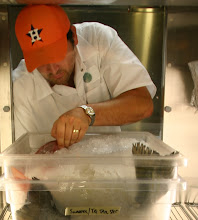
7. ICE 'EM SWIMMING

Stack the fish head to tail like they are swimming in the ice. Do this one layer after another. Fish that have been cared for using the tips above and then iced correctly can last up to 1 ½ weeks and sometimes longer.


Ice 'Em Swimming