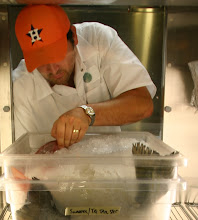
Luna & Caz
Last Sunday was a benchmark day for me and my three-man crew: James Cheramie, Dan Lantini (from Barstool Magazine) and Chef David Luna from Shade.

Lantini Working the Bow

Cheramie with Bull Red


Seas were 1 to 2 feet (see swell height ), blue water was in close and weed lines were forming just five miles off the beach head. In every direction you looked, the entire Gulf was alive, teeming with massive bait pods, Gulls and Terns pounding the water’s surface, thrashing Spanish Mackerel, bruiser Kingfish and Cobia!
Within five minutes of rolling up to the first rig, the anchor hadn’t even caught, and Dan was hollerin’ almost as loud as his Ambassador 7000 was screaming, “I’m on, baby!” It was that quick: four Kingfish in the boat before I could even wet a line. And that’s the way it was for about one and a half hours.
Within five minutes of rolling up to the first rig, the anchor hadn’t even caught, and Dan was hollerin’ almost as loud as his Ambassador 7000 was screaming, “I’m on, baby!” It was that quick: four Kingfish in the boat before I could even wet a line. And that’s the way it was for about one and a half hours.

Luna with Kingfish
Then I noticed something: on the Southeast corner of the rig, a beautiful and wondrous sight -- nervous water. Large bait pods of Atlantic Bumper and Spanish Sardine huddled ever-so-close to the rig’s pylons, nervous as Tom Turkey in Dog Town.

Searching for Nervous Water
Keeping a close eye on it, I knew it was no lie, something had ‘em spooked. And then it happened…BAM! The surface erupted -- murder and mayhem, scales and hard tails flying in random directions. They scattered hard, then regrouped even tighter than the rush hour crowd on the 6 train. Then BAM!, again. Ooohh, son! Something big was methodically working the edges. This was no Mackerel, this big guy had shoulders and was throwing his weight around.
I was about to come out of my skin with anticipation. Repositioning the boat, I palmed that baby up to the edge of the ruckus. Dan chunked a frozen sardine on a float and, almost instantly, a massive shadow emerged from the rig pilings, rushing Dan’s bait but stopping inches short, turning up his nose at the frozen offering. Sure enough, it was a big-ass Cobia. As quick as I could, I snatched up my live bait rig, single hook and 80 pound mono leader (make no mistake, I might be big and a bit clumsy, but at moments like these, you sometimes only get one shot -- clarity is key and, baby, I’m a killer). I grabbed one of the live Spanish Sardine that I caught earlier jigging Sabiki and pitched it lightly, landing it just shy of Dan’s float. The Cobia charges the frantic Sardine, mouths it, spits it, circles, takes a dramatic pause, then hits it like a Tyson right cross, inhaling the bait and then taking off like a champagne cork. It was on! A rush of adrenaline blasted through my veins as this 40-plus pound monster manhandled me from port to starboard, making me doubt what I’ve come to believe: my knots, my drag, this crew, my religion. I started coaching Luna on his gaff technique, as if he grew up in Montana, spewing anxious, incoherent chatter that gets me a stern look from him and he finally says, “Dude, I got it.” Then, the giant hits the deck – pay dirt, baby! I really should give lessons.


I was about to come out of my skin with anticipation. Repositioning the boat, I palmed that baby up to the edge of the ruckus. Dan chunked a frozen sardine on a float and, almost instantly, a massive shadow emerged from the rig pilings, rushing Dan’s bait but stopping inches short, turning up his nose at the frozen offering. Sure enough, it was a big-ass Cobia. As quick as I could, I snatched up my live bait rig, single hook and 80 pound mono leader (make no mistake, I might be big and a bit clumsy, but at moments like these, you sometimes only get one shot -- clarity is key and, baby, I’m a killer). I grabbed one of the live Spanish Sardine that I caught earlier jigging Sabiki and pitched it lightly, landing it just shy of Dan’s float. The Cobia charges the frantic Sardine, mouths it, spits it, circles, takes a dramatic pause, then hits it like a Tyson right cross, inhaling the bait and then taking off like a champagne cork. It was on! A rush of adrenaline blasted through my veins as this 40-plus pound monster manhandled me from port to starboard, making me doubt what I’ve come to believe: my knots, my drag, this crew, my religion. I started coaching Luna on his gaff technique, as if he grew up in Montana, spewing anxious, incoherent chatter that gets me a stern look from him and he finally says, “Dude, I got it.” Then, the giant hits the deck – pay dirt, baby! I really should give lessons.


This was the kind of day that sticks with you, like a Rueben at 2nd Ave Deli, weighing you down, swelling your thoughts of the next trip. And I’ve been obsessing ever since.