Tripletail
West Matagorda has always been my fishing home base. One of the unique things about this bay is the large number of inshore gas platforms that offer great surface structure in an otherwise structure-less bay. Each rig reaches 12 feet down to the bottom of the bay and has become a reef of sorts; the large oyster shell pads that were built on the bottom to reinforce the platform, although man-made initially, have become alive over the years, creating an eco-chain of life out in the middle of the bay. They are also the reason why West Matagorda Bay is the Tripletail capital of Texas.
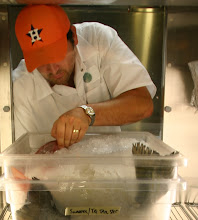
Tripletail (aka Black fish, Drift Fish or Buoy Fish [Lobotes surnamensis]) gets its name because the second dorsal and anal fins that extend far back on the body make it look like it has three tails. Although it is the only representative of the Lobotes family in the Gulf, many wrongly believe it is related to the Cichlid family because of its striking resemblance to the fresh water “Sac-a-lait” or Crappie. Tripletail is a surface fish that hangs out next to any kind of top water structure like platforms, sargassum, buoys and flotsam and jetsam. I caught this one last week off of a large piece of driftwood about one and half miles offshore of the Galveston jetty.
West Matagorda has always been my fishing home base. One of the unique things about this bay is the large number of inshore gas platforms that offer great surface structure in an otherwise structure-less bay. Each rig reaches 12 feet down to the bottom of the bay and has become a reef of sorts; the large oyster shell pads that were built on the bottom to reinforce the platform, although man-made initially, have become alive over the years, creating an eco-chain of life out in the middle of the bay. They are also the reason why West Matagorda Bay is the Tripletail capital of Texas.
Tripletail (aka Black fish, Drift Fish or Buoy Fish [Lobotes surnamensis]) gets its name because the second dorsal and anal fins that extend far back on the body make it look like it has three tails. Although it is the only representative of the Lobotes family in the Gulf, many wrongly believe it is related to the Cichlid family because of its striking resemblance to the fresh water “Sac-a-lait” or Crappie. Tripletail is a surface fish that hangs out next to any kind of top water structure like platforms, sargassum, buoys and flotsam and jetsam. I caught this one last week off of a large piece of driftwood about one and half miles offshore of the Galveston jetty.

That's me with a Tripletail
A Tripletail will lie on its side, as if it was part of whatever floating material it’s hiding in; floating and moving with the current and waves like a large leaf, it even has the ability to change its color, like a chameleon. Years back, most people would steer clear of Tripletail as table fare thinking that these characteristics meant that the fish was sick. But it’s not sick, it’s smart: it lays in wait, ready to spring on its prey. When it attacks, it rushes, swimming on its side just like a flounder. But once it is hooked, it rights itself, turns that broad body and uses it against you. They are infamous as tough fighters that will frequently return to their former hiding spot, wrapping you around the seaweed or driftwood or whatever they were using as cover, and breaking your line. Tripletail feed mostly on menhaden, herring, anchovies and some crustaceans and live in subtropical and tropical coastal regions and estuaries from Massachusetts to Argentina. Rarely traveling in groups of more than three, they reach sexual maturity in just a year, making it an easily sustainable and recovery species. When large enough, they yield a wonderfully flaky white fish reminiscent of a giant speckled trout or weakfish. Although difficult to cook on the grill, they are excellent on the flat top or in a sauté pan.

Roasted Tripletail, Smoked Dr. Pepper Glaze, Buttered Bok Choy, Grapefruit Soda