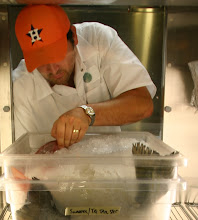
Whole Fish

Gulf Seafood + Southern Food


Almaco Jack Filet

In a previous post, I talked about the Almaco Jack or Longfin Yellowtail coming out of the Gulf, which shocked me with its resemblance to farm-raised Yellowtail-Hamachi and Almaco -Kona Kampachi coming out of the Pacific. Now that you’ve had the history lesson, let’s get to the eating part. Different proteins call for different applications, some are versatile while others aren’t. The Almaco Jack, although very good in hot applications, shines tremendously on the cold/raw side.

At Reef, we love experimenting with contrasts in texture in relation to how the fish structure changes under certain applications. For this dish, we used somewhat of a “short” cure to alter the outer flesh while still retaining the integrity and silkiness of the inner part of the filet.

Kanzuri Cure...Curing

The cure consists of a ratio of 3 to 1 sugar to salt (which many would consider high on the sweet side for a cure). For the sweet end of the deal, we use palm sugar and agave nectar; on the salt side, sea salt and Kanzuri Paste. Kanzuri paste is a very interesting product -- it’s a fermented chili paste from the mountains of Japan where the peppers have been exposed to the snow (kind of a frost bit deal), mixed with salt and malt, then fermented for around three years. It has a deep, complex, salty heat. Together with the sweet and the salt, we mix crushed jalapenos, shallots, mint and lime zest. The fish then sets to cure for around three to four hours depending on the thickness of the filet.

To plate the dish: we place sliced cucumbers between the pieces of cured fish, add cucumber water and some pureed cure marinade (fresh, not used!) and there you have it!


Kanzuri Cured Longfin Yellowtail, Cucumber Water and Mint

2.20.2009

Ice ‘Em Swimming

The first hour after a fish is harvested is by far the most crucial time in its stored life. Proper procedure and care immediately after a fish is harvested can add three to six full days of shelf-life (depending on the varietal). As a fish cook and a fisherman, my processing etiquette on the boat can be flat-out obsessive but, if you follow these steps, you can enjoy your fresh-caught fish for well over a week and skip the sacrilege of sending them to the freezer.

1. DON'T PULL THEM GREEN

Horsing a fish will usually result in two things: one, he will break off, causing that heartbreaking, hollow numbness that instantly washes over your body after your line goes flaccid, leaving you with either excuses or rage; or two, he will tear up both the boat and his muscle fibers once inside the boat. Those torn muscle fibers result in blown blood vessels and soft or mushy protein. Take your time, enjoy, wear him out, there are no points for speed.

2. SWIFT AND INSTANT

Now is the time when speed and points come into play. If the fish is big enough to gaff, get him in the boat, pop him once, hard, right behind the eyes (gaff placement is key) -- be swift and kind -- then get him covered in ice, completely. If he is not gaff-size, then just put him straight into the ice. There are certain species that benefit greatly from bleeding; most of these fall into the large, faster-moving Pelagic-type fish, especially tuna which have the ability to control there own body temperature. During feeding frenzies their internal body temperature can rise to 85-90 degrees; bleeding greatly improves your ability to quickly lower their internal temperature (wahoo, sharks and large jacks do not share this ability but can still benefit from this technique).

3. ICE MANAGEMENT

You can never bring enough ice. All too often, I will look into a fish-filled cooler with nothing but water and two cubes of ice. You need to cover those babies like they’re wrapped in a wool blanket in the wintertime. I always start the day with one of my coolers filled with clean ice and the others half full. If time or space is an issue, check out those new Yeti’s - it’s a new breed of cooler whose insulation is far superior to any others. I use them both on the boat and in the kitchen. Saltwater slurries, which can reach temperatures well below freezing, are also an option for a quick chill.

4. DRAINAGE

Always roll with the cooler plug open. Standing water is your biggest enemy when it comes to proliferation of bacteria. Nothing could be worse than your fish sitting in water.

5. TIME ON ICE

Depending on the size of the fish, they need at least 3-6 hours on ice. Fish that have not had the opportunity to complete the cooling process and reach - and complete - full rigor will greatly affect ease of processing on the cleaning table and reduce your yield percentage. In many cases, with the muscle fibers still active, the meat of the filet will seize up, shrink and become extremely tough and spongy when cooked.

6. BACK AT THE DOCK

Here is where you have to make a very important decision: (1) Do you clean the fish at that dock table on top of the water-swollen, green plywood table-top in the hot, bright, afternoon sun? Or (2) Can you take them home to a controlled, clean, sanitized environment? If the answer is (2) then you first need to gut the fish and wash out the stomach cavity before heading home. If you do have to clean them at the dock, make sure you bring a large plastic cutting board and at least one large stainless sheet pan from a restaurant supply store. Also don’t be afraid to bring your own sanitizing solution (1 cap of bleach per gallon of water). As you separate the first filet from the bone, place it skin side down on the sheet pan; then place the second one flesh to flesh. After you complete the fish in this way, sanitize the board and then begin to take the skin off of each filet. The skin and scales are like a protective coating keeping bacteria from the flesh and, in turn, harbor most of these undesirables. Do whatever you can to keep the two from touching.

7. ICE 'EM SWIMMING

Stack the fish head to tail like they are swimming in the ice. Do this one layer after another. Fish that have been cared for using the tips above and then iced correctly can last up to 1 ½ weeks and sometimes longer.


Ice 'Em Swimming

The Carangidae family of fish, or Jacks as they are commonly called, is one of the more diverse varietals in the Gulf. The Greater Amberjack, Pompano, and Permit are some of the more well-known species, but there are many lesser-known, but equally as tasty Jacks: Black Trevally, Rainbow Runner, Palometa and Almaco. Jacks are fast-swimming predatory, Pelagic fish (meaning they live in the water column in the open sea closer to the water’s surface, no more than about 1000 meters deep) that hunt surrounding reefs or the open seas.

There are about 151 species of Jacks worldwide. In the Gulf, my best count is about 25 species, 14 of which I would consider plate-worthy, but recently it seems as if I am introduced to a different species every month.


Almaco Jack or Longfin yellowtail

The Almaco Jack or Longfin Yellowtail (Seriola rivoliana) is the second largest of the Amberjack clan and, even though it takes heat very well, I believe it is one of the best fish coming out of the Gulf to serve raw. I started seeing them at the docks about 9 months ago and my crew and I at Reef originally pegged it to be a younger Greater Amberjack, but once I took a knife to it I noticed a serious difference.


Almaco filet


The muscle structure and shape were identical to the farm-raised Yellowtail-Hamachi and Almaco -Kona Kampachi coming out of the Pacific. So I sliced a piece, hit it with a little sea salt and down the hatch it went…Ooooh City! Amazing! Sweet thing, where have you been all my life? After a little research, I found that the Almaco Jack can be easily differentiated from the Greater Amberjack by the elongated dorsal and anal fins that have a definite sickle shape.


Other unusual and tasty Jacks that have passed through the Reef doors lately: Black Trevally, Rainbow Runner, African Pompano, Bar Jack, and Look Down.


Stay Tuned for Part 2...

Now, this ain’t no shit! About two and a half years ago, in February, I was down at our bay shack in Carancahua Bay, Texas. A good friend of mine, Brendon Treanor (who is also a chef), was getting married, so a group of us guys hauled down to the bay for a couple of days of feasting and fishing. The first order of business whenever I get down to the bay is to bait and put out the crab traps. Ever since I was a kid, the thought of BBQ Blue Crab always got my motor running.


BLUE CRAB!

That evening, after we got off the water, I pulled the traps and there they were -- mad as hell and tasty to boot -- along with the Red’s in the cooler, it would be Redfish on the Half-Shell and BBQ Crab tonight!


BBQ Crab

Morning brought an abrupt awakening by the Wild Turkey’s call, hung-over and hungry. I rummaged through the leftovers in the fridge -- that beautiful BBQ crab was now going to become breakfast. Everyone got to work: C. Busker pulled out the blender, a little OJ and vodka; Micheal Watts was chopping it up with chorizo and eggs on the stove; Treanor and I tackled the crabs. With a pair of sharp scissors, a couple of frozen screwdrivers and Willie in the background, this is what was born that morning:


Jumbo Lump Crab Lollipop

Jumbo Lump is by far the most sought-after part of the Blue crab and, at $20 a pound, it beats out almost any other protein in cost. The Blue Crab (Callinectes sapidus) has two swimmer fins opposite its claws on the back side. The Jumbo Lump is the muscle that is attached to the Coxa, the first joint of each of the swimmer fins or swimmer legs.


Anatomy of a Blue Crab © 2006 Steven C. Zinski.

Now, we were thinking, if a man was able to get this type of thing in large quantities, you know, steady-like, and if every one he received were like these – big, beautiful lumps with the handle, or well, leg attached…well, now, that would be one hell of a thing! He might just have something.

That Lollipop stuck in my head. When REEF opened a few months later, I got to know Jim Gossen, the founder and CEO of a local seafood company called Louisiana Foods. Jim loves his shellfish more than anyone else I’ve ever met, I mean he carries a salinometer around in his pocket; that, my friends, is True Love. So I told him my Lollipop idea, his eyes lit up in excitement and he left abruptly. Two weeks later, I looked up during service and he was standing across the “pass” (where the food passes from the kitchen to the dining room and where you’ll always find me), sporting a $100 grin and a bag in his hand. I had my first pound of Jumbo Lump Crab Lollipops for REEF.
Talk about a fairytale!

Well, y’all know the difference between a fairytale and bullshit, don’t you?

A fairytale starts off with “Once upon a time…”, and the other, “Now, this ain’t no shit…”.